How to Unblock a Toilet Fast: Safe DIY Steps & 24/7 Milton Keynes Expert Help
Dealing with a blocked toilet or a slow-draining toilet pan is one of the most stressful household plumbing emergencies. If the water level in your bowl has dropped low enough to work safely, soft blockages caused by excess toilet paper can often be cleared in 15 minutes using simple household items.
Below, our engineers at M1 Drainage Service walk you through three safe, professional-approved DIY methods to clear a minor toilet clog—plus the critical warning signs that mean the blockage is deeper in your external underground drain.
3 Safe DIY Methods to Unblock a Toilet at Home
The Washing-Up Liquid & Warm Water Trick
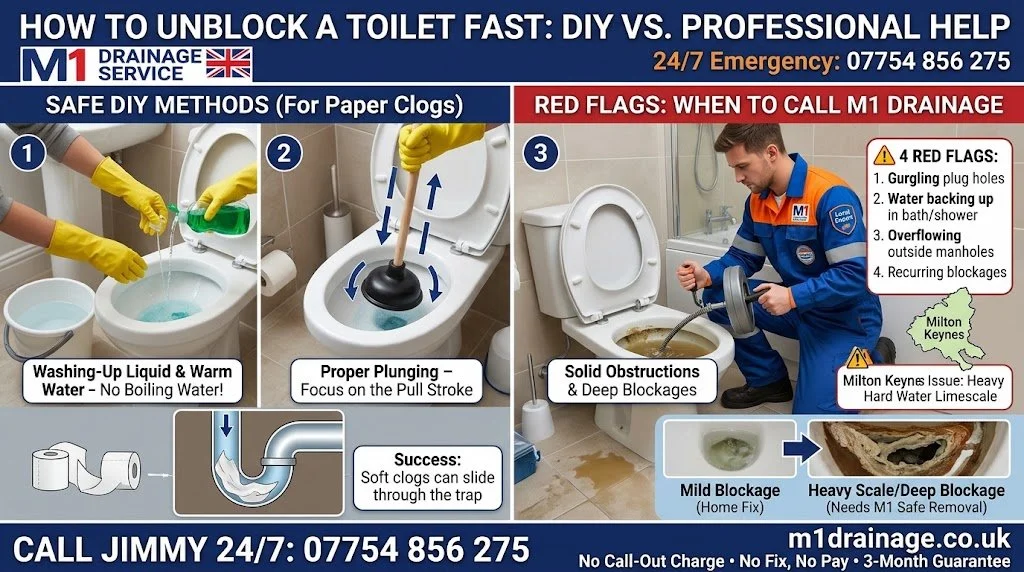
If you don't have a plunger handy, liquid dish soap and warm water can lubricate the porcelain U-bend and slide a soft tissue blockage straight into the soil pipe.
- Squirt roughly half a cup of washing-up liquid directly into the toilet bowl. The dense soap sinks to the bottom of the trap and coats the porcelain walls to reduce friction.
- Leave it for 10 minutes to soak into the tissue plug.
- Fill a bucket with warm-to-hot tap water. (Never use boiling water from a kettle—thermal shock can crack a porcelain toilet bowl or melt rubber pan connector seals!)
- Pour the warm water into the pan from waist height. The gravity and pressure of the falling water often pushes the lubricated blockage straight through the bend.
How to Plunge a Blocked Toilet Properly
Most people plunge too fast without sealing the bottom of the pan, which simply agitates the water. To shift a stubborn blockage, you need hydraulic vacuum pressure:
- Use a Flange or Bellows Plunger: Standard flat cup sink plungers cannot create an airtight seal inside the curved throat of a modern UK toilet bowl.
- Soften the Rubber First: Run the plunger head under hot tap water for 30 seconds. Soft rubber moulds tightly to the porcelain trap.
- Burp the Air Out: Place the plunger firmly over the outlet hole at the bottom of the bowl and push down gently once to release trapped air bubbles.
- Pump Pull-and-Push: Keep the seal locked and pump vigorously up and down 10 to 15 times. Pulling back sucks the blockage loose rather than ramming it tighter into the bend.
- Break the Seal Sharply: On the final stroke, pull the plunger sharply upwards to send a rush of water down the soil stack.
Using a Flexible Toilet Auger (Avoid Wire Coat Hangers!)
If wet wipes, heavy tissue buildup, or a plastic clip-on rim block cage has fallen down the toilet, plunging won't move it.
- Never poke a wire coat hanger down the pan: Unwound metal hangers leave permanent dark grey scratches on white porcelain and frequently snap or wedge inside the U-bend.
- Use a Hand-Cranked Toilet Auger: A specialist toilet snake features a protective PVC guard to protect your bowl while feeding a flexible steel cable around the tight S-bend to hook and retrieve solid objects.
Pouring heavy chemical drain cleaners or caustic soda granules down a blocked toilet is dangerous and ineffective. Because chemicals are heavier than water, they pool in the porcelain U-bend and generate intense heat—warping plastic waste pipes and perishing rubber pan connectors. Worse still, if the chemical fails to clear the blockage, you cannot plunge the toilet safely without risking severe acid splashback burns.
Why Do Toilets Keep Blocking in Milton Keynes & Bletchley?
Working every day across Milton Keynes, Bletchley, Newport Pagnell, Wolverton, Stony Stratford, and Buckingham, we find that repeat toilet blockages are rarely caused by the toilet itself. Instead, local water conditions and estate pipework are usually to blame:
1. Severe Milton Keynes Hard Water Limescale
Milton Keynes has extremely hard, mineral-rich chalk water. Over time, thick calcified limescale builds up inside the toilet swan-neck and cast-iron or PVC soil pipe. This rough scale snags toilet paper on every flush. Plunging won't remove calcified rock—it requires professional mechanical drain descaling.
2. Tree Roots & Shifted Clay Pipes (Older MK Estates)
In established areas like Bletchley (MK2/MK3), Wolverton, Fenny Stratford, and Olney, older salt-glazed clay underground drains often suffer from root ingress or dropped joints. Waste catches on the roots outside, backing sewage up into your downstairs toilet.
3. Tight Bends & Low-Flush Cisterns (New Builds)
Modern estates like Whitehouse, Fairfields, Brooklands, Newton Leys, and Tattenhoe use eco dual-flush cisterns and long horizontal plastic pipe runs. Low water volume combined with "flushable" wet wipes quickly creates blockages in shared manhole chambers.
4. Faulty Cisterns & Weak Flush Valves
If your toilet takes two or three flushes to clear paper, a worn siphon or faulty filler valve may only be releasing half a tank of water. Replacing the internal valve restores full flushing power immediately.
🛑 4 Red Flags: When to Stop Plunging & Call a Drainage Engineer
If you notice any of these symptoms, stop DIY plunging immediately. Your blockage is not in the toilet pan—it is deeper inside your underground sewer line or external inspection chamber:
- Gurgling Drains: You hear bubbling or gurgling noises coming from your bathroom sink, bath, or shower plug hole whenever the toilet is flushed.
- Water Backing Up Elsewhere: Dirty water rises up into your ground-floor shower tray or bath when taps or appliances are run.
- Overflowing Outside Manhole or Gully: Your external drain grid or manhole cover in the garden or driveway is seeping water or smells strongly of sewage.
- Recurring Weekly Blockages: Your toilet unblocks temporarily after plunging, only to block again a few days later (a classic sign of heavy limescale, root intrusion, or a collapsed pipe).
Fast, Guaranteed Toilet & Drain Unblocking Across Milton Keynes
When DIY fixes aren't enough, M1 Drainage Service clears 99% of domestic and commercial blockages on the spot—with zero mess left behind in your bathroom:
- Rapid 45-Minute Emergency Response: Local engineer based right here in Bletchley, covering all MK postcodes (MK1–MK19), Bedfordshire, Buckinghamshire, and Northamptonshire.
- No Call-Out Fee & No Fix, No Pay: Fixed, transparent pricing agreed upfront. If we cannot clear your blockage, you pay nothing.
- Specialist Equipment On Van: Commercial rotary toilet augers, 4000 PSI high-pressure water jetting, mechanical limescale descaling, and HD CCTV drain surveys to inspect hidden pipe faults.
- 3-Month Blockage Guarantee: Every clearance is backed by our 90-day peace-of-mind guarantee.
Frequently Asked Questions: Blocked Toilets
Will a blocked toilet eventually go down on its own?
A minor blockage caused purely by soft toilet tissue may slowly break down and seep away over several hours. However, if the blockage contains "flushable" wet wipes, sanitary products, kitchen roll, a dropped plastic rim block, or heavy Milton Keynes limescale, it will not dissolve on its own and requires mechanical clearance.
Why does my toilet bowl fill to the top and then drain away very slowly?
When water rises to the rim and takes 15 to 30 minutes to slowly drop down, you have a partial obstruction in the soil stack or external underground drain line. Trapped air and waste prevent the flush siphon from pulling water away at full speed.
Can I use baking soda and vinegar to unblock a toilet?
Baking soda and white vinegar create a mild fizzing reaction that can help deodorise a drain or loosen light soap scum, but it rarely has enough hydraulic force to shift a compacted toilet blockage or wet wipes wedged in the trap.
How much does it cost to unblock a toilet in Milton Keynes?
At M1 Drainage Service, we charge zero call-out fees and provide an upfront fixed price before starting work. All clearances include our No Fix, No Pay promise and a 3-Month Blockage Guarantee. Call 07754 856 275 for an instant quote.
Explore Related M1 Drainage Services & Local Coverage
Need specialist help beyond a blocked toilet? Explore our core drainage and guttering services across your area:
Areas Covered 24/7: Milton Keynes (MK1–MK19), Bletchley, Newport Pagnell, Wolverton, Stony Stratford, Woburn Sands, Olney, Buckingham, Towcester, Brackley, Leighton Buzzard, Bedford, Kempston, Flitwick, Ampthill, Dunstable, Luton, Northampton, Aylesbury & Enfield (North London).