

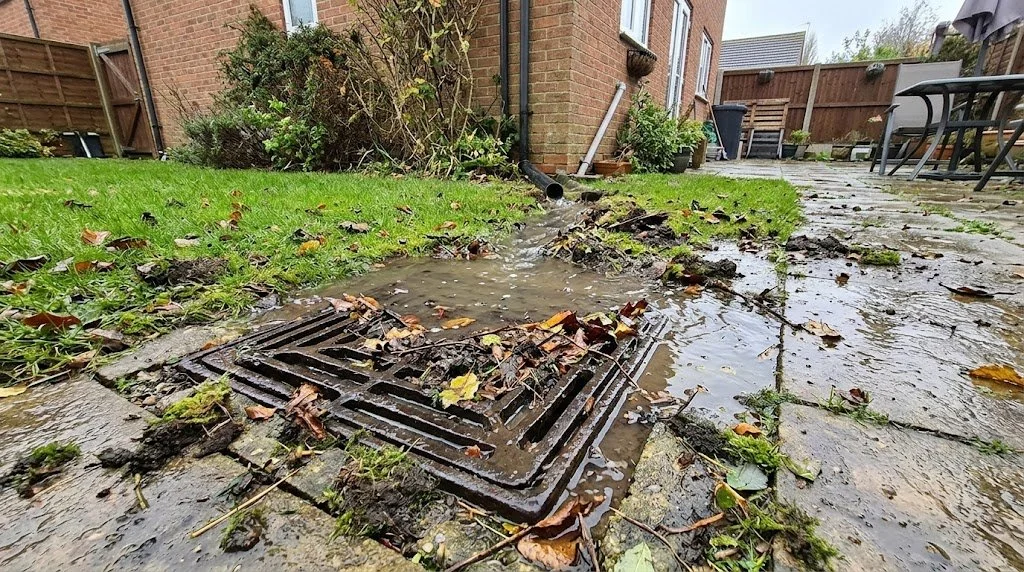
There is nothing quite as unpleasant—or alarming—as stepping out into your back garden after heavy rain or a load of laundry to find wastewater pooling on your lawn, patio, or driveway. A clogged, overflowing outside gully or garden drain isn’t just an eyesore; it carries foul sewer smells, risks structural foundation damp, and poses a genuine health hazard to pets and children.
Whether you live in a new build in Brooklands or Whitehouse, an established 1970s estate in Bletchley, or a period cottage in Stony Stratford or Newport Pagnell, external drainage issues are surprisingly common across the Milton Keynes grid system.
In this practical guide, Jimmy from M1 Drainage Service explains why garden drains back up, who is legally responsible for fixing them, how to troubleshoot safely, and when to call a professional.
What Causes Garden Drains to Overflow in Milton Keynes?
Garden gullies are designed to take surface stormwater runoff, rainwater downpipes, and frequently kitchen or utility waste (sinks and washing machines). Here are the most common culprits:
Autumn Leaf Fall & Garden Debris: MK’s lush parkland grid roads and mature garden trees mean rotting leaves, twigs, soil, and mulch frequently slip past open gully grates, creating a dense plug.
Fatbergs & Kitchen Grease (FOG): Hot cooking oil and melted butter look liquid when poured down the sink, but as soon as they hit the cold underground PVC or clay pipes in your garden, they solidify into rock-hard blockages.
Flushed "Unflushables" (Baby Wipes & Sanitary Products): Wet wipes, even those labelled "flushable," do not dissolve. They snag on pipe joins, creating a net that catches toilet paper and raw waste until the sewer backs up into your lowest garden inspection chamber.
Heavy Storm Surges: Sudden downpours across Buckinghamshire can overwhelm local soakaways and communal sewers, backing water up through external gullies.
Sub-surface Tree Root Intrusion: Tree and shrub roots seek out moisture through microscopic hairline fractures in older clay sewer pipes, expanding inside the pipe until flow stops completely.
Who Is Responsible? You or Anglian Water?
Before spending hours digging or worrying about bills, establish who owns the affected pipe:
Private Drain (Your Responsibility): Any pipe, gully, or chamber that serves only your property and sits within your property boundary is your responsibility to maintain and clear.
Lateral Drain & Public Sewer (Anglian Water's Responsibility): Since the 2011 sewer transfer regulations, once a sewer pipe crosses your property boundary OR merges with wastewater from a neighbour's property (a shared drain), responsibility transfers to your water undertaker (Anglian Water in Milton Keynes).
Quick Tip: Pop your head over the fence or speak to your immediate neighbour. If their garden drain or toilet is also backing up at the same time, the issue is almost certainly in the shared lateral sewer line. In that case, call Anglian Water on 03457 145 145. If only your garden gully is affected, the blockage is within your private system.
Step-by-Step: How to Safely Check and Clear a Garden Drain
If you feel confident inspecting the issue yourself, follow these safety steps:
Safety Gear Required:
Heavy-duty rubber/waterproof gloves
Protective eye goggles
Sturdy boots or wellies
Disinfectant / drain cleaner
Step 1: Stop Running Internal Water Immediately
Do not run the washing machine, dishwasher, bath, or flush toilets. All internal greywater and blackwater will only add to the pool forming in your garden.
Step 2: Remove the Grate and Clear Surface Mulch
Using gloves and a small trowel or shovel, remove the top plastic or cast iron gully grid. Clear away the accumulated top layer of leaves, soil, and hair. Often, clearing the top trap is enough to let backed-up surface water drain away.
Step 3: Check the Nearest Inspection Chamber (Manhole)
Locate the nearest inspection chamber lid in your lawn or patio. Carefully pry it open using drain keys or a flat-head crowbar:
If the manhole is dry/empty: The blockage is between your house/garden gully and this chamber.
If the manhole is full of standing, murky water: The blockage is downstream (further along towards the road/boundary sewer).
Step 4: Use Drain Rods with Care
If you have standard screw-together chimney/drain rods:
Rule #1: Always twist the rods clockwise! If you turn them anticlockwise inside an underground bend, the rods will unscrew and become permanently stuck in your drain, turning a simple blockage into an expensive excavation.
Attach a plunger or worm screw end, guide it gently into the pipe run, and push towards the blockage.
When to Stop and Call a Drainage Engineer
Garden drainage problems can quickly escalate if forced. Stop and call a local specialist if:
Sewage or toilet waste is bubbling up: Handling raw sewage carries severe risks of E. coli and leptospirosis (Weil's disease).
Drain rods hit a hard, immovable object: This indicates collapsed Victorian clay pipes, heavy scale, or severe tree root ingress.
The water level doesn't drop after rodding: Persistent blockages require high-pressure water jetting (HPWJ) to strip fats and scale from the pipe circumference.
You smell recurring foul odours: A cracked trap or displaced underground collar may require a professional CCTV drain camera survey.
Frequently Asked Questions (FAQ)
Why is dirty water coming up into my garden drain when I run the washing machine?
Your kitchen and utility pipes connect to the garden gully trap. If grease, lint, and detergent scum have narrowed the gully outlet, the sudden high volume of pumped water from your washing machine cannot escape fast enough, causing it to overflow into your garden.
Will bleach or boiling water clear an overflowing garden drain?
Boiling water and soda crystals can sometimes dissolve small superficial grease blockages inside an indoor kitchen trap. However, underground external pipes hold cold standing water; boiling water cools down within seconds before it ever reaches the core blockage. Chemical unblockers rarely work on external blockages and can be dangerous to work around.
How much does it cost to unblock an outside drain in Milton Keynes?
At M1 Drainage Service, we believe in 100% upfront pricing. Unlike national call-centre franchises that charge hidden hourly fees or expensive call-outs, Jimmy provides transparent fixed quotes with £0 call-out charge and a No-Fix, No-Fee guarantee. Standard clearances usually start from £60–£85 depending on the cause.
Can tree roots break underground drainage pipes?
Yes. Milton Keynes has heavy clay soil which expands and contracts with the seasons. This movement creates small cracks in joints where micro-roots enter. Over time, root balls fill the pipe bore. We clear these using specialist mechanical spinning cutters and high-pressure jetting.
Helpful Local Drainage & Homeowner Resources
Explore our other practical guides and service pages:
Emergency Blocked Drain Services in Milton Keynes – Fast 30–60 minute response times across MK1 to MK19.
How High-Pressure Drain Jetting Works (And Why It Beats Rodding) – Learn how 3000+ PSI water blasts away stubborn fatbergs.
CCTV Drain Surveys Explained: Finding Underground Pipe Collapses – Clear video footage and insurance reports for your home.
Blocked Toilets & Sinks: Fast DIY Fixes Before You Call a Plumber – Troubleshooting indoor back-ups.
Official Anglian Water Report a Problem Portal – Check public sewer outages and shared lateral issues.
Need Jimmy On-Site Today? Fast, Local Help Across Milton Keynes
Don't let dirty garden runoff ruin your lawn or creep under your floorboards. Speak directly with an experienced local engineer—no call centres, no sales reps.
Engineer: Jimmy
Business: M1 Drainage Service
Website: www.m1drainage.co.uk
Direct Emergency Phone / WhatsApp: 07754 856275
Operating Hours: 24 Hours / 7 Days a week
Areas Covered: Milton Keynes (Bletchley, Wolverton, Shenley, Stony Stratford, Newport Pagnell), Leighton Buzzard, Towcester, and surrounding villages.
